Essays
Seven Common Mistakes New Essayists Make (and How to Fix Them)
Every essay starts out rough. That is not evidence that you cannot write; it is what a first draft is for. What separates an essay that holds a reader from one that quietly loses them is rarely talent or vocabulary. It is a handful of habits — most of them easy to spot once you know what to look for, and easier still to repair.
What follows are the seven slips that turn up most often in early drafts, with a fix for each.
Mistake one: a theme too broad to argue
I want to write about friendship. Fine as an impulse, useless as an essay. A theme is a subject; an essay needs a claim about that subject, something a reasonable person could push back on. Why I stopped lending money to friends gives you somewhere to go. Friendship is important does not.
The contradiction test
Write your working title at the top of the page and ask whether anyone could disagree with it. If the answer is no, cut the scope in half and ask again. Narrow by time, place, person or moment: not grief, but the week after the funeral, when you kept buying two loaves of bread out of habit. Specificity is not a limitation. It is the thing that lets a reader in.
Mistake two: clearing your throat before you begin
A great many openings exist only to delay the essay. Since the dawn of time, people have told stories. The dictionary defines love as… In recent years, conversations around… The reader has not yet been given a reason to care, and you have spent your best sentence on nothing.
The fix comes in two parts. First, delete your opening paragraph outright and read the essay from the second one. More often than not, the piece genuinely starts there — and what you cut was warm-up. Second, decide what kind of opening you actually want. A scene earns attention. A claim earns disagreement. A question you intend to answer earns curiosity. Any of the three will do; a throat-clearing paragraph will not.
Mistake three: over-explaining
This is the most damaging habit in otherwise good writing, and it reads like this: a sharp observation, followed by a sentence explaining the observation, followed by another sentence explaining the explanation. The effect is a reader who feels talked down to and an essay that never quite trusts its own material.
The repair is to say it once, in the best way you can, then stop. If a sentence begins What I mean by this is… or This shows that…, check whether it does any work the previous sentence had not already done. Usually it does not. Cut it and read the paragraph again. Trust that your reader is intelligent, attentive and slightly impatient — which is exactly the reader you want.
Mistake four: losing the thread
Essays drift when each paragraph is written in response to the one before it rather than to a plan. The result can read well sentence by sentence and still go nowhere.
A paragraph earns its place by doing three things:
- making a claim — a sentence someone could argue with;
- offering evidence — an example, a scene, a detail, a piece of reasoning;
- saying what follows from it — the consequence for your argument.
Write the essay as a list of claims first: one line per paragraph, no prose. If two lines say the same thing, merge them. If one does not follow from the last, move it or drop it. Only then write the paragraphs out properly. The piece will feel tighter, and you will write it faster.
Mistake five: asserting instead of showing
It was a difficult period for my family. True, perhaps, and completely inert. Readers believe what they can picture. The difficult period is the unpaid bill left on the hall table, the way your mother started taking phone calls in the hallway, the birthday nobody mentioned.
This is not about decorating plain statements with adjectives. It is about evidence. An abstraction makes a claim; a concrete detail makes the case for it. As a working rule, follow every general statement with something specific enough to see, smell or hear.
Mistake six: endings that repeat or apologise
There are two weak endings, and both are common. The first summarises: So, as we have seen, friendship matters because… The reader already knows; you told them. The second backs away: Of course, this is only my opinion, and everyone's experience is different. Hedging in the final line throws away the authority the rest of the essay worked to build.
An ending should do small, honest work. Turn the argument a degree further. Follow it to its consequence. Return to the opening image and let it mean something else now. End on the strongest sentence you have, not on a farewell. If you cannot find that sentence, the essay probably stopped one paragraph too late — or started one idea too early.
Mistake seven: revising for typos and calling it done
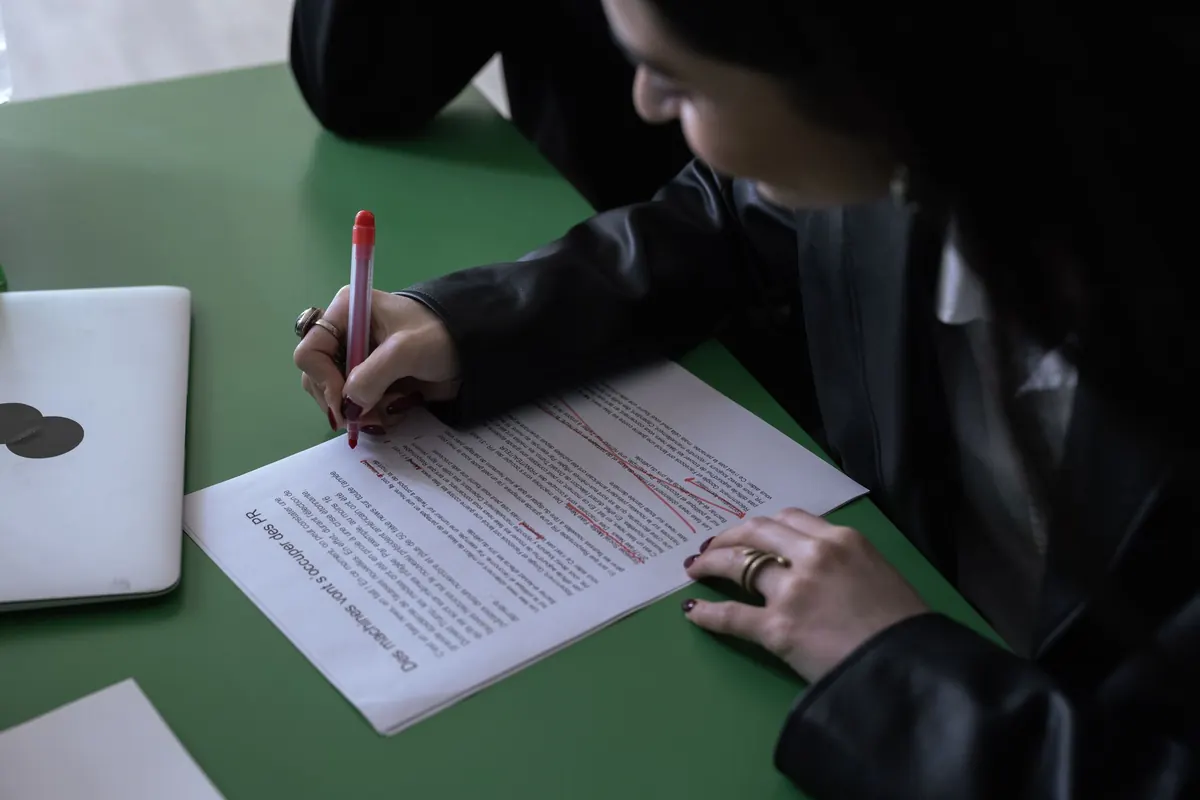
Revising is not the same as proofreading, and it is not one pass. Most repair work happens in the structure, long before you worry about commas. Four passes, in this order, will catch nearly everything:
- Structure. Read only the first sentence of each paragraph. Do they form a coherent argument on their own? If not, no amount of line editing will fix it.
- Cuts. Remove roughly a tenth of the words: adverbs, throat-clearing, doubled adjectives, sentences that restate the one before. Almost every draft improves.
- Sentences. Read aloud. Where you stumble, the reader will stumble. Vary the lengths — a long sentence followed by a short one does more than either alone.
- Proofreading. Last and slowest, ideally on paper or in a different format. Spelling, punctuation, names, dates. This is the only pass that is about correctness.
A routine that keeps the worst of it out
None of these mistakes disappear with experience; they simply get caught earlier. A workable routine: write the first draft quickly, in one sitting if you can, without stopping to fix anything. Leave it overnight. Run the four passes above, in order, and then hand it to one honest reader with a single question attached — where did you get bored?
You will not enjoy every answer. Use it anyway. The essay that survives that question is the one worth sending out.
Photo: cottonbro studio / Pexels